Mostrando entradas con la etiqueta Roma. Mostrar todas las entradas

jueves, 14 de abril de 2011

Mary Beard en Washington


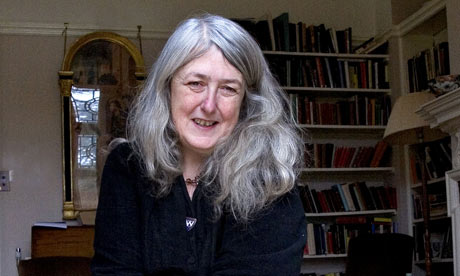
Mary Beard es una profesora de Cambridge, escritora, comunicadora y con un blog muy interesante que nunca me canso de leer(A Don's Life), especializada en la antigua Roma tiene dos libros sobre esta época, El triunfo de Roma y Pompeya, ambos publicados por la editorial Critica en español, participa en varios programas de televisión y por si fuera poco también escribe en el suplemento literario del periódico Times de Londres. Ahora la profesora esta por Washington donde participa en una serie de charlas sobre "los 12 Cesares, Imagenes del Poder desde la Roma Antigua hasta Salvador Dali", aquí un reportaje en el Washington Post sobre su visita y roguémosle a los Geek que cuelguen la charla. No sabía que El general Washington tenía una estatua parecida a la de Zeus en la ciudad capital, si había leído que se le consideraba el Cincinato de la joven República pero no una Deidad tipo Padre todopoderoso, que locura, bueno esto y algunos otros temas sobre la influencia de Roma en Estados Unidos son abordados por Mary Beard


______________________________________________________________________
2011 Mellon Lectures feature Mary Beard’s take on ‘12 Caesars’ By Philip Kennicott.


When Mary Beard takes the stage of the National Gallery of Art on Sunday afternoon, she will join one of the most distinguished lists of intellectual luminaries ever assembled. Beard, who holds a chair in classics at Cambridge University, is a renowned lecturer, a brilliant communicator and a distinguished scholar. But the woman chosen to give the prestigious 2011 Mellon Lectures has also appeared on a reality television series, is an avid blogger, a frequent presence in English newspapers and the host of a BBC documentary series. If there are still rules about how far academics can stray from the Ivory Tower, she has probably breached them. Even more surprising, her work as a prosyletizer for the classics seems to come easily to her. Her blog, A Don’s Life, is written with an unstrained mix of the personal and professional, the chatty and the erudite. Her books — which include an introduction to the Parthenon, a history of the traditional Roman victory celebration, a general survey of ancient classical art (with John Henderson) and a guide to motherhood — never condescend or simplify, even when dealing with the minutiae of 2,000-year-old texts written in dead languages. Her first-person essays, which have explored fearlessly autobiographical subjects such as the death of her parents and being victim of a sexual assault, mix classical reference and daily observation without a trace of the ostentatious or didactic.


Her life as a public intellectual is seamless with her academic work. Established by the National Gallery of Art in honor of Andrew Mellon in 1949, the Mellon Lectures are Washington’s annual opportunity to see top scholars think in public. But the talks almost always end up published in book form, so their content must rise to a level that bears sustained scrutiny. Scholars tend to throw out topics with very grand-sounding names — Sources of Romantic Thought, or Art and Reality — but it’s rare that someone arrives with a subject quite so catnippy to local intellectual obsessions: “The Twelve Caesars: Images of Power From Ancient Rome to Salvador Dali.” Before you block off a half-dozen spring afternoons, however, it’s worth remembering one thing about Beard’s work: Her scholarship tends to dismantle as much as it constructs, and where others might find easy analogies between the imperial presidency and the old psychopaths who governed imperial Rome, Beard tends to see discontinuity, contradiction, misapprehension and faulty transmission of facts, names and just about everything else. At the end of her 2007 study of the Roman triumph — the traditional victory lap taken by vainglorious generals — she professed herself not very interested in the “why” of what the Romans were about when they paraded through the streets with captives, slaves and other booty on display.


The “why” of it was both unknowable and reductive, and after more than 300 pages of explaining why the “why” was elusive, she concluded thus: “It was also a cultural idea, a ‘ritual in ink,’ a trope of power, a metaphor of love, a thorn in the side, a world view, a dangerous hyperbole, a marker of time, of change, and continuity. ‘Why’ questions do not reach the heart of those issues.” Beard, 56, finds Washington a puzzling place. “It’s this whole city, built on this inheritance from Rome, and you can’t even see a bloody sarcophagus,” she says. And she’s right, mostly. The National Gallery of Art has an astonishingly rich collection, but nothing to speak of when it comes to ancient Greek or Roman art. And Washington’s architectural language and iconography may scream “ancient Rome,” but with more irony than clarity. “It’s terribly easy to say, and I’ve been guilty of this in the past, that America is modeling itself on Rome,” she says. “There isn’t a country in the West that hasn’t at some time said we’re the New Romans. But why Rome? What bit are we like?” For Beard, images of power are always complex. They aren’t always meant simply to overawe the masses, or give coherence to a ruler’s agenda. Often, they are meant to be reflected back at the ruler himself, a kind of existential confirmation that he is indeed the president of this, or emperor of that. And while Americans, and Washingtonians in particular, live surrounded by an overlay of Roman iconography, it’s not entirely clear why we once so fetishized the Caesars. An obvious and painfully embarrassing example of our uneasy relation to Rome is an infamous 1841 statue of George Washington, by Horatio Greenough. Commissioned for the 1832 centennial of Washington’s birth, it shows the father of the country bare-chested, enthroned on a classical chair and pointing heavenward, rather like a famous Greek statue of Zeus one can see at the Getty Museum in Los Angeles.
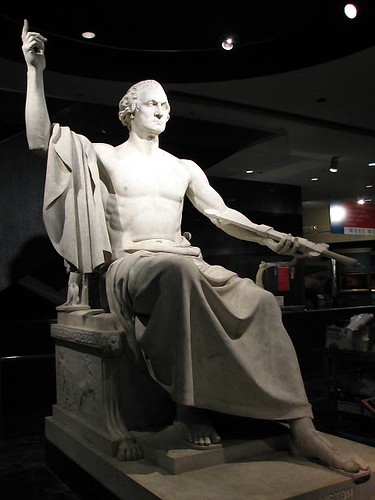

Although it sat on the East Lawn of the Capitol for more than 60 years, Greenough’s Washington never gained an audience. It was, somehow, ridiculous and obscene for an American hero to be depicted as a semi-naked deity. “There is a terrible problem for poor, old Greenough: How do you represent a president or an American you admire in Roman guise and not make him look like an emperor?” says Beard. The problem is exacerbated by the lack of Roman portraiture from the Republican era that preceded Julius Caesar and his adopted successor, the emperor Augustus. And it is made more difficult by the fact that even the Roman Republicans were hardly models for American politicians in the early years of the nation. “Here I am, an upstanding democrat, am I really like Cincinnatus?” asks Beard, referring to the Roman hero most often compared with Washington (and memorialized in the name of the Society of the Cincinnati, with its national headquarters on Massachusetts Avenue). But Cincinnatus, as described by Livy, wasn’t just a model of the dutiful citizen, he was saturated with patrician contempt for the masses. Greenough’s statue will make an appearance in Beard’s lectures, along with the fascinating story of an ancient Roman sarcophagus, purchased in the 19th century by an ardent admirer of Andrew Jackson. It was offered to Jackson for his final resting place, but Jackson refused. “Jackson writes back terribly huffy, saying ‘I’m not going to be buried in an emperor’s tomb,’ ” says Beard.


The odyssey of the sarcophagus after its rejection by Jackson, a restless journey from one B-list Washington spot to another, is as interesting to Beard as the provenance of the object itself. These stories, supplemented by others from the Renaissance and the Enlightenment, are part of a series of questions that Beard will explore. When did the mystique of Roman power iconography begin to fade? (Sometime around the First World War, with outliers well into the past century.) Beard says she also wants to take the public well beyond the familiar territory of marble busts, into other art forms, including painting, a rich trove of material she knows intimately from having studied Pompeii. Beard will also examine disparate other forms of art and iconography, including coins, ancient silver cups, tapestries, cookie molds, cameos and Renaissance painting. And she mentions a photograph, found by a respondent to her blog, of Franklin Delano Roosevelt at a toga party. “He wasn’t a kid” when it was made, she says. “Was that a joke? Was he being set up?” She is as much interested in transmission through the centuries of an image as she is in the original function or meaning of the image (which more often than not we can’t divine).


An example from her history of classical art shows how historical misunderstanding of ancient objects can create powerful new ideas and art, giving scholars layers upon layers of stories, none of which is privileged just because it is more or less ancient. When a statue of an old man, in what seems to be physical agony, was discovered during the Renaissance, it was assumed to be Seneca, the tutor and ultimately victim of Nero. So famous was Seneca’s forced suicide, in a bath, that someone decided to add a tub to the statue, to make the Senecan connection obvious. Peter Paul Rubens then based his 1608 painting of “The Death of Seneca” on the statue, which is now believed to represent an old fisherman. And thus an iconic image of stoicism and speaking truth to power is downgraded to peasant bathos, and one hunts in vain for it in the standard English-language visitor’s guide to the Louvre, where it was once a show-stopper. Beard’s skepticism is, in part, a reflection of an increasingly methodical way of doing business in the small subset of the humanities known as classicism. Judith Hallett, a classics scholar at the University of Maryland, says she admires most a book Beard wrote about another classicist, Jane Ellen Harrison, who died in 1928. It might seem like a meta-meta project, studying a woman who was one of the powerhouse academics during another century. But it was also about making sense of how the academy worked, how women could negotiate it, who won and lost in the game. And those aren’t necessarily inside-baseball questions. “Classics is fueled by what questions we decide to ask the ancient world,” says Beard. And the politics of the academy, and the society at large, help determine who does the asking, and what’s permissible. One might add, it’s also about who hears the question, and Beard is remarkable for how well she has managed to be heard beyond the confines of the academy. “If only we had someone like Mary here,” says Hallett, “because she is still in the classroom and still in the library, but she has this very vocal and influential role to play.” Garry Wills, the Pulitzer Prize-winning historian who says that he will read anything Beard writes, sees her as part of a particularly British tradition of erudition combined with “pride in literary style.” He admires her blog, which is “very chatty, and funny, brings the classics up to date.” But mostly he admires her tenacious sifting of evidence.


Classics, he says “is mostly recycling reports from the early days of admiring the great classical heroes and authors, and they are often very flimsily based.” Beard is willing to disappoint readers, and other scholars, who may want certainty where there is little more than propaganda and hagiography, often written centuries after the events took place. Tony Grafton, a scholar at Princeton University, borrows a distinction from the Yale historian Jack Hexter, who divided historians into “lumpers” and “splitters.” The former look for the big idea and see all evidence as lumped underneath it; the latter focus on detail, and generally chisel away at overarching theories, splitting in the name of accuracy rather than lumping in the interest of synthesis. Beard’s work, he says “is very granular, very precise,” which makes it all the more remarkable that she’s had the kind of public career she’s had. She’s a splitter’s splitter. “The splitters tend to get the most esteem within the academy,” he says, “while the lumpers get it outside.” Think, say, Jared Diamond, whose “Guns, Germs and Steel” offered a big-idea thesis that also hit the best-seller lists. But Beard, through elegant writing, and un­or­tho­dox routes of engaging the public, has managed the even more difficult challenge of being an academic splitter who is (in Britain, at least) a household name. And, says Wills, Beard has a sense of humor.


The first page of her book on the Parthenon includes a quote from Shaquille O’Neal, in response to the question of whether he had visited the Parthenon while in Greece. “I can’t really remember the names of the clubs we went to,” Shaq said. It’s a funny line, but it makes larger sense after reading Beard’s book, which takes on some of the larger ideological battles about the meaning and ownership of the most famous building from classical antiquity. The Parthenon, as idea, far transcends the mere Parthenon as building, and Shaq’s quote is a coy acknowledgment that we can never remember all the names of anything. “In more cases than you can imagine, we haven’t the foggiest clue when some of these images were made,” Beard says of a bust of the Roman emperor Commodus, also in the Getty Museum. “Some people get very frustrated,” she says. “Is it ancient, or is it 17th century? But that’s part of the excitement. We don’t know.”


Tomado del Washington Post, Lifestyle


http://www.washingtonpost.com/lifestyle/style/2011-mellon-lectures-feature-mary-beards-take-on-12-caesars/2011/03/21/AFfJExbB_story.html

jueves, 4 de marzo de 2010

Carthago delenda est. Nuevo libro sobre las guerras Punicas.


Si no mal recuerdo el historiador Adrian Goldsworthy menciona en su libro sobre las guerras Púnicas que lo que lo motivo a escribir un libro sobre este periodo tan importante de la historia de Roma fue los muchos vacios en las escuelas y la falta de un libro de fácil acceso para los interesados en el conflicto. Bueno hoy leyendo la pagina web de la revista de historia de la BBC encontré una reseña del nuevo libro de Richard Miles dedicado al conflicto que cambio el balance del poder en el mediterráneo y que según el autor fue uno de los momentos más peligrosos para los Romanos, con pérdidas de hasta 100,000 hombres en varias batallas, Roma se logro levantar contra todo pronóstico. Bueno les dejo la reseña en ingles del profesor Richard Alston y pondremos el libro en la lista de posibles adquisiciones.


______________________________________________________________________
Carthage must be Destroyed.
Richard Alston looks at an expert account of a civilisation that was defeated and humiliated by the Roman empire

The great war between Rome and Carthage transformed the balance of power within the Mediterranean. For three centuries Rome had been expanding within Italy, but only in the last decades of the third century BC had it achieved sufficient power to challenge the states of the Greek east and the African empire of Carthage. In the late third century BC, the Carthaginian general, Hannibal, invaded Italy after an epic march across the Alps. He inflicted a catastrophic series of defeats on Rome. In three battles between 218 and 216 BC, the Romans lost more than 100,000 troops, perhaps as much as half of the adult male population. Rome’s allies in southern Italy defected. But Rome stood firm. In 202 BC, just 15 years later, the Roman general Scipio Africanus defeated Hannibal at the battle of Zama, and Rome stood at the gates of Carthage.

This was Rome’s great patriotic war, the moment at which the Roman character appeared to be at its strongest and to which all future generations would look back with pride. The humiliating terms that Rome inflicted on Carthage were not, however, enough to break the city. Two generations later, on the slightest of pretexts, Rome again declared war on the Carthaginians and in 146 BC Carthage was destroyed. The Hannibalic war was to be the last serious challenge to the power of Rome until, six centuries later, the barbarians crossed the frozen Rhine to set in train the events that brought an end to the Roman empire in the west.

All histories of Carthage start from the moment of its eclipse. So thoroughly was Carthage destroyed that our knowledge of its rich culture relies almost exclusively on the writings of its enemies. Carthage’s own histories are lost and even for the period before Carthage came into conflict with Rome, we rely on the accounts of Carthage’s enemies, the historians of the Greek cities of Italy, for our understanding of Carthaginian history. Archaeology can be used as a partial counter to these accounts, but the Roman destruction of the city was so complete that we have little chance of resurrecting an alternative history of the city from its remains. What modern historians have to draw upon is hostile and propagandistic fragments, a task equivalent to writing a history of Germany 1914–45 from American and English populist accounts.

Richard Miles’s account expertly weaves together these unpromising fragments into a coherent and balanced account. Carthage, founded by Tyre, emerges as a politically and culturally complex city. While maintaining its distinctive semitic cultural features, especially in religious practices, Carthaginian culture drew on several different traditions, notably Greek and Egyptian. Carthage also played a crucial role in the dissemination of ideas across the Mediterranean. Carthaginian traders served the trade routes along which cultures spread, Carthaginian influence in Spain and Italy being particularly pronounced. Carthage has often been represented as a merchant empire, and differentiated from the military empires of Alexander and Rome, and yet we know very little about how the Carthaginians managed and benefited from their trade networks, how their traders were represented in the politics of the city, and to what extent the economy of Carthage differed from that of the other great cities of the Mediterranean. Yet, there is just enough evidence to suggest that Carthage had a very different political system from that of the states of the Greek and Roman world.

Inevitably, Miles’s history centres on military matters, for that is where our Greek and Roman sources focus. The wars were notable for their brutality, outstanding even by ancient standards. Captives were slaughtered, prisoners tortured, towns razed and their populations sold into slavery.

Miles stresses the propaganda battle, suggesting that Greek and Roman writers sought to depict the wars as being about a struggle for a way of life rather than the control of a few towns in Sicily. In retrospect, that was what the conflict was to become: a moment in which the Romans learnt they were in opposition to their great enemy in the west, and we are left to wonder how different history would have been had Hannibal been able to drive home his spectacular victories and make this Semitic-African city mistress of the world.

Richard Alston is professor of Roman history at Royal Holloway University of London.

Tomado de la pagina web de BBC History Magazine.

jueves, 3 de diciembre de 2009

Latrinae et Foricae


Estoy seguro que si lo menciono en una plática de amigos quedaría como un gran mentiroso y bromista de primera, pero como decía uno de mis viejos profesores, a las pruebas me remito, aquí uno de los libros más originales en el tema histórico romano, Letrinas Romanas, yo también me pregunte lo mismo que muchos de ustedes cuando miren el titulo, y para que un libro sobre las letrinas romanas, bueno la respuesta de seguro que debe estar en el libro pero para los que no se deciden aventurarse todavía en el mundo más bajo de la antigua roma pues léanse la reseña de Désirée Scholten en el blog de History Today.
--------------------------------------------------------------------------------------------------
Latrinae et Foricae opens with the question ‘why, you may ask, a book on Roman toilets?’, words which were a relief to me (no pun intended), as they reveal that the author is conscious of the oddity of his chosen topic. And yet, who can deny that the lavatory has become one of the most important rooms in our homes? My second question, ‘Why would anyone do this?’, was also answered almost immediately. The author was, until his retirement, a GP. His career combined with his studies in archaeology at the University of Bradford ‘caused an interest in hygiene and disease [in relation to] the distribution of latrines in the community and their situation within individual buildings […] and perception of the development of the provision of facilities over time […].’

However, this trend of answering questions is limited to the preface. The main shortcoming of Hobson’s book lies in its organisation. The first three chapters provide an introduction to toilets in the Roman world, Roman Britain, and Pompeii. They essentially constitute a summary of recent excavation projects during which toilets have been found. However, whilst the appearances of the objects are described and some contextualising facts provided, no interpretative conclusions are drawn. It is not until the last two chapters (chapters 12 and 13) that the reader understands the purpose of the previous descriptive chapters about relatively unfamiliar artefacts. Thus the various features of individual types of lavatories, which are described at length in the first three chapters, are eventually interpreted. To an extent, chapters 12 and 13 should be read first in order to make full sense of the preceding ones.

With the exception of the last two chapters and two others about drains and the location of toilets, the book tends to lack criticism. Hobson has carried out a lot of work in the field and his expertise is obvious from the thoroughness of the examples used. His book is also well-argued; however, in the sections where the author has to lean on secondary literature this attitude disappears. The book fails to move beyond given theories and to explain the pros and cons of a particular theory as given by other authors, or the author’s own opinion on the matter. In pages 81-82, for example, Hobson asks a very legitimate question about gender and the use of toilets and issues of privacy and modesty. He presents the views of various authors, but no real answers are given and the author reassumes his discussion on shared and separate toilets with modern assumptions on gender and embarrassment.

Moreover, Hobson tends to make references to classical literature without considering the specific genre of the works which he quotes. This is particularly true when quoting satiric plays, for example. The author’s interpretations of certain quotes are also, at times, unconvincing. Hobson quotes the Latin poet Martial (p.111), for example: ‘Philaenis wears purple-dyed garments every night and day, but she is not ostentations or haughty, she likes the odour, not the colour.’ He concludes from this quote that Philaenis wears purple because the smell of the purple dye disguises her body odour. But that is not what it says; it says that she likes the scent. In this case, Hobson’s conclusion is in my view a bit premature and needs further explanation to convince me.

Latrinae et Foricae is primarily a survey rather than a well-balanced study on a new topic. Much more could have been made of it, especially since the many pictures of the sites make it easy to follow the author’s descriptions. With its detailed descriptions and illustrations, the book is of great value to those who are already familiar with the topic. However, many chapters lack critical assessment to the extent that the book remains, above all, an inventory of lavatories.


Reseña tomada de Latrinae et Foricae: Toilets in the Roman World, Barry Hobson (Duckworth)
Desiree Scholten is an MA student in Medieval Studies at the University of Utrecht.

sábado, 29 de agosto de 2009

Maestro de biógrafos

Un pequeño articulo de Carlos Garcia Gual, catedrático de filología griega en la Universidad Complutense de Madrid. Especialista en antigüedad clásica y literatura.
---------------------------------------------------------
CARLOS GARCÍA GUAL 29/08/2009
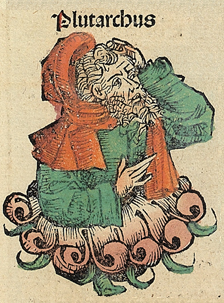
Plutarco dice que el biógrafo debe actuar como un buen pintor que observa y resalta la expresión de los ojos y el rostro para reflejar sus rasgos personales de su modelo. Escudriña "los signos del alma", esos gestos en los que el carácter individual se revela en el decurso de una vida e imprime su huella en la historia. Una biografía es un fino retrato post mortem, que permite evaluar psicológica y éticamente una trayectoria vital, y recuerda un perfil humano irrepetible. Biografía es palabra griega, pero no de época clásica (aparece tarde, en el siglo V después de Cristo); los antiguos denominaban bíos (vida) a este género literario. Plutarco señala con acierto que al biógrafo le interesan menos los sucesos externos que las palabras, las vivencias y los actos singulares de sus héroes; al historiador le deja la descripción de las batallas y conflictos sociales. Una biografía debe albergar las mejores anécdotas, los gestos decisivos, el ingenio y el talante que definen para siempre a sus protagonistas, ejemplares héroes en el teatro de la historia. Gran lector de textos históricos, Plutarco trató de ser sólo un buen biógrafo, es decir, un retratista de las grandes figuras del pasado de Grecia y Roma. A la vez fue un moralista que evalúa conductas, analiza virtudes y defectos, y resalta la areté heroica y el destino trágico de sus personajes. Situó hábilmente en parejas las vidas de griegos y romanos, en la variada serie de sus Vidas paralelas (Alejandro y César, Demóstenes y Cicerón, Demetrio y Antonio, etcétera) para contrastar sus perfiles en sus contextos históricos.

Esas casi cincuenta Vidas paralelas forman una galería de retratos de vivaz dramatismo e intenso patetismo, lo que no sólo proviene de la turbulenta escena y sus grandes actores, sino también del talento narrativo del escritor. En él culmina el arte de la biografía. Plutarco ha sido uno de los clásicos más editado y leído desde el Renacimiento hasta finales del siglo XIX, y tuvo numerosos y grandes admiradores -desde Erasmo, Montaigne y Shakespeare hasta Goethe, Rousseau, Napoleón y muchos más, que admiraron la antigüedad como el escenario de los grandes héroes de Plutarco.

Ahora tenemos, por fin, una traducción actualizada de las Vidas paralelas (y de las Moralia) de Plutarco. Acaba de publicarse el tomo VII y se anuncia el último, el VIII, de la versión completa, anotada y bien prologada en la Biblioteca Clásica Gredos. Traducir la extensísima obra es una ardua tarea, incluso cuando se hace entre varios. Ésta sustituye a la meritoria versión de Ranz Romanillos (de 1830) y pone al alcance de los lectores una traducción fiel, precisa y anotada, como el gran autor se merecía.


-------------------------------------------------------------------------------------------------

Plutarco nace en la región griega de Beocia, probablemente durante el gobierno del emperador romano Claudio. Realizó muchos viajes por el mundo mediterráneo, incluyendo uno a Egipto y dos viajes a Roma. Gracias a la capacidad económica de sus padres, Plutarco estudió filosofía, retórica y matemáticas en la Academia de Atenas sobre el año 67.

Algunos de sus amigos fueron muy influyentes, incluyendo a
Soscio Senecio y a Fundano, ambos importantes senadores y a los cuales dedicó algunos de sus últimos escritos. La mayor parte de su vida la pasó en Queronea, donde fue iniciado en los misterios del dios griego Apolo. Sin embargo, sus obligaciones como el mayor de los dos sacerdotes de Apolo en el Oráculo de Delfos (donde era el responsable de interpretar los augurios de la o las pitonisas del oráculo) ocupaban aparentemente una parte pequeña de su tiempo. Llevó una vida social y cívica muy activa, además de producir una gran cantidad de escritos, parte de los cuales aún existen.

Más moralista que filósofo e historiador, fue uno de los últimos grandes representantes del
helenismo durante la segunda sofística, cuando ya tocaba a su fin, y uno de los grandes de la literatura helénica de todos los tiempos.

viernes, 31 de julio de 2009

Espartaco y Pepsi

El esclavo tracio que lidero una gran rebelión de gladiadores contra Roma, conocida como Tercera Guerra Servil pero me gusta mas el nombre que le da Plutarco “Guerra de los Gladiadores” ha sido fuente de inspiración para muchos revolucionarios y pensadores que fueron convirtiendo la imagen del líder de la revuelta en un símbolo contra la esclavitud, Marx, Che Guevara, lo nombraron héroe, la realidad es que poco se conoce de los orígenes del líder de los Esclavos.

Mejor dejemos al buen Apiano para que nos diga un poco mas sobre este problemático esclavo:

"Al mismo tiempo, Espartaco, un Tracio de nacimiento, que habían servido como un soldado con los romanos, pero desde hace algún tiempo había caído como prisionero y fue vendido como gladiador, cuando estaba en la escuela de gladiadores de Capua , persuadió a unos setenta de sus compañeros para que se rebelaran por su libertad y para que no siguieran siendo la diversión de los espectadores. Superaron a los guardias y huyeron, se armaron con palos y puñales que les quitaban a las personas que se encontraban en los caminos, y se refugiaron en el Monte Vesubio. Ahí se le unieron muchos esclavos e inclusive hombres libres, con los cuales saquearon todas las comarcas vecinas, " Apiano, Guerras Civiles, 1.116.

Encontré este video publicitario de Pepsi, usando imágenes de la película de Stanley Kubrik “Spartacus”, la idea esta tremenda,

viernes, 24 de abril de 2009

Los retratos de El Fayum

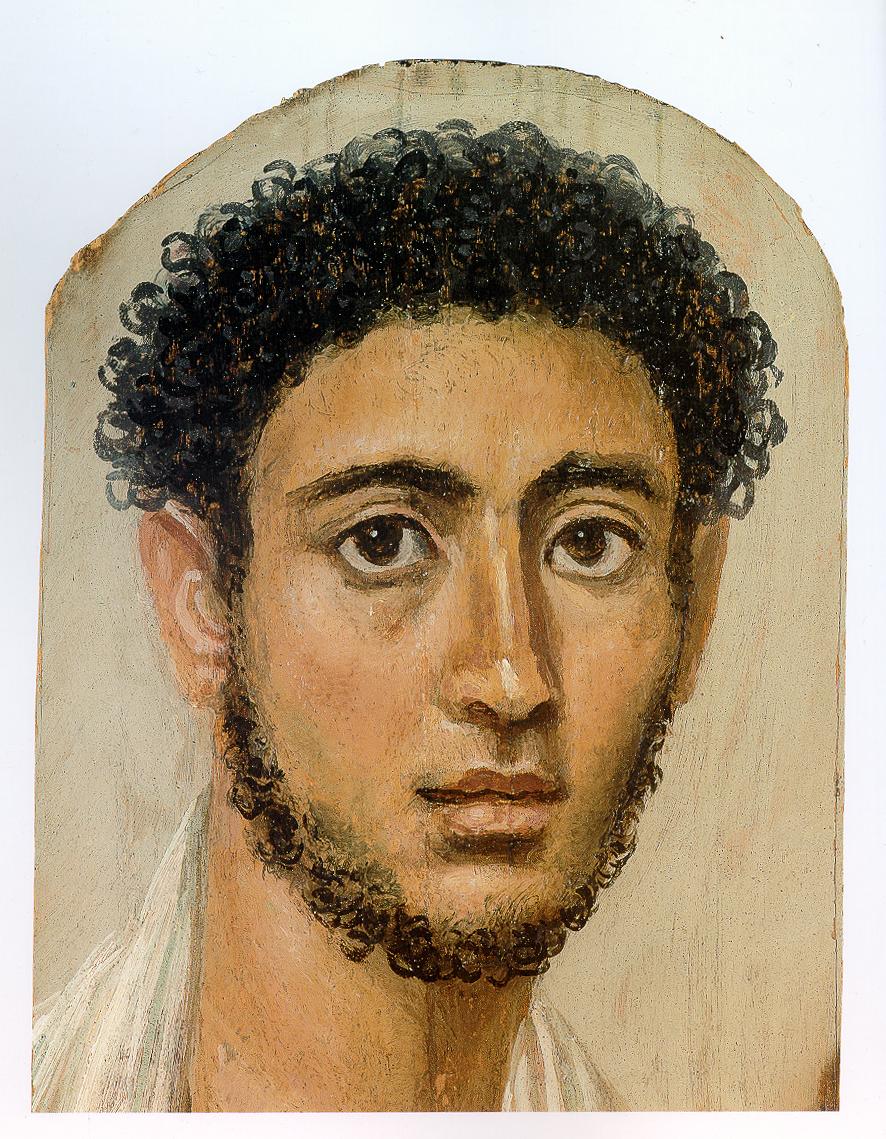
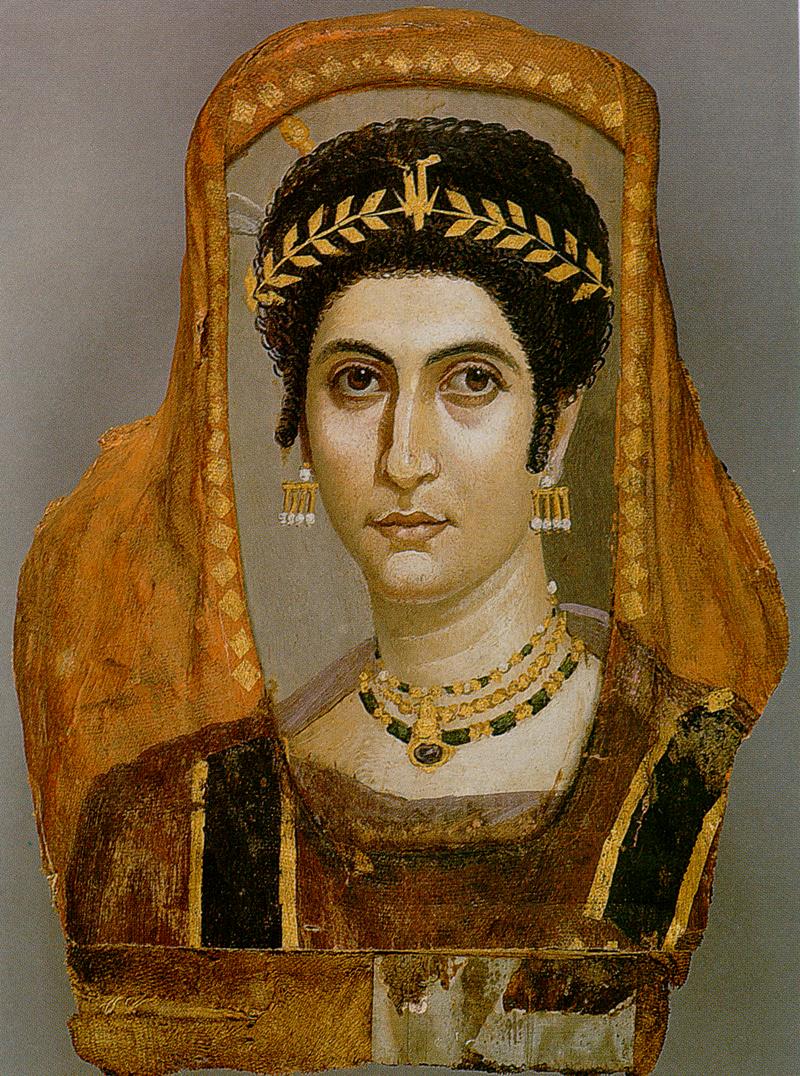
Que mejor ejemplo sobre la fusión de tres culturas que los retratos de El Fayum, esa fusión de tres civilizaciones, la Romana, la egipcia y la Griega, sus expresiones, asombran a todos los que la miran por primera vez, esas miradas intensas que nos persiguen son difíciles de dejar de ver. Destinados a ser depósitos sobre las momias, según la tradición funeraria del antiguo Egipto, fueron realizados por artistas conocedores de las convenciones griegas entre el siglo I y III d.c., cuando el Egipto había pasado hacer una colonia Romana. Los retratos eran fijados sobre la cara del cuerpo momificado, muy influenciados por la tradición de mascaras fúnebres, además de pintarlo sobre un pedazo de madera, también se han encontrado en tejidos que rodeaban la cara de la momia.


Estas pinturas funerarias con sus grandes ojos negros son los precursores de los iconos bizantinos, influenciado profundamente el arte copto, fueron la transición entre el arte pagano y el arte cristiano. En su gran mayoría representan personas jóvenes, tal vez una imagen idealizada del fallecido de parte de sus familiares. Aunque la costumbre de momificar era egipcia, las vestimentas, peinados o adornos son griegos. Hoy se pueden ver en los grandes museos del mundo, otras víctimas del saqueo arqueológico, pero que sin duda nos abren una ventada al pasado.


martes, 21 de abril de 2009

Reseña de How Rome Fell de Goldsworthy

El nuevo libro de Goldsworthy se mira muy prometedor, según una reseña en el Wall Street Journal, el autor de grandes obras sobre Julio Cesar,Las guerras Punicas, el ejercito romano y grandes generales del imperio romano, se lanza en la línea de los seguidores de Gibbon, "Como cayo Roma". How Rome Fell By Adrian Goldsworthy (Yale University Press, 531 pages, $32.50)


______________________________________
The Emperor Left Town
Weak leaders, failed military campaigns and a few lessons for imperialists.

By
PETER STOTHARD
The fall of the Roman Empire has never been a cheerful subject for those with empires of their own. Imperialists who in later centuries wished to dominate large areas of the globe argued sometimes that the first millennium was irrelevant to their times, sometimes that the collapse of the greatest ancient power came from causes wholly absent in their modern empires and sometimes that the Roman fall did offer parallels -- but only for the imperialist regimes of other people. That an imperial machine as massive as Rome's might, for no clear reasons, cease to function has long brought varying degrees of disquiet and does so still today.


Adrian Goldsworthy's "How Rome Fell" begins and ends with reflections on Edward Gibbon, whose classic work of the 1770s and 1780s, "The Decline and Fall of the Roman Empire," set a standard for all successors. Mr. Goldsworthy sees Gibbon as instinctively relating imperial Rome to imperial London and growing ever more pessimistic as the years swept by. When the first volume of "The Decline and Fall" appeared in 1776, the prospect of Britain keeping its American colonies seemed bright. By the time of the second and third volumes, in 1781, Britain's trans-Atlantic empire was trundling shakily toward Yorktown. In 1788, Americans were able to read the final three volumes in a new country. The tone of the great British historian, Mr. Goldsworthy says, took a noticeable change during this time.


His own tone toward Britain -- Mr. Goldsworthy is himself British -- moves equally toward depression. He notes that, like the Roman Empire in the fourth and fifth centuries, his country has had a growing share of incompetence, corruption and blatant deceitfulness. It, too, has seen the number and the power of military bureaucrats rise while the number of soldiers has fallen. This sort of comparison, seemingly inevitable for its subject, emerges from various passages in "How Rome Fell" but does intrude directly upon Mr. Goldsworthy's story. Like Gibbon himself, whose sense of living with two declining empires comes less from his history than from his letters, Mr. Goldsworthy is eager to give primacy to his narrative. He covers a shorter time period than Gibbon but tells us clearly and well -- and without attempts at literary majesty -- about the series of events that brought Rome's western empire to a state of collapse.
There were mad, bad emperors, of course, campaigns lost against Persians, Germans and Gauls, and the imposition of Christianity in extreme and intolerant forms. There was the Persian capture and life-imprisonment of Emperor Valerian in 260. Those looking for decisive battles often choose Adrianople in 378, when the Goths killed Emperor Valens and some 10,000 of his men on what is now the Greco-Turkish border. The fifth-century emperors, a succession of generals, children and chancers, showed flexibility but little foresight.

Although Britain's decline is much on Mr. Goldsworthy'smind, the U.S. is the main focus of his practical historiography. Predominantly a military historian, he has enjoyed the attention of Washington policy makers eager to learn about the similarities between then and now -- overstretched forces, domestic greed, declining shared values, determined foreign foes. It is "an odd sensation," he says, "for an historian to talk to an audience that is actually listening to what you are saying." In universities it is more common for the members of a seminar to be thinking about their own contribution in reply. Americans, he discovers, are also more likely to have taken a general classics course and to have some knowledge, at least in outline, of the time between Julius Caesar and the beginning of the Middle Ages.

How exactly did the Roman Empire fall? One sure answer is "slowly." It did not collapse like the 20th- century empires of Germany, Japan and the Soviet Union. Another answer is "violently." It was long a useful orthodoxy for the founders of the European Union that their continent had developed inevitably, almost gently, from a Roman Empire to the first Franco-German axis. But some excellent books for general readers in the past few years, notably Brian Ward- Perkins's "The Fall of Rome and the End of Civilization" (2005), have shown how devastating was the economic and human cost paid between 450 and 900. It is still unfashionable to speak of the Dark Ages (there was continuing cultural life), but these were certainly the Poor Ages, in which protection for the weak and vulnerable, from roaming killers and even from the weather, was much more precarious than it had been under Roman rule.

When did the fall begin? Mr. Goldsworthy gives a vivid account of one the periods most often cited, the four years following 192 A.D., when Rome tottered under the weight of its responsibilities and the weakness of its leaders. He focuses on the murders of Commodus (the first emperor to be born the natural heir to a reigning father) and then of his chaotic successors, Pertinax (whose father was a freed slave) and Julianus (who bought the office at auction). After them came the African, Septimius Severus, who has attracted recent attention as Rome's "first black emperor," although Mr. Goldsworthy follows the line that he may have been merely a bit dark-skinned. Anyway, he is judged to have shown no thinking that was different from that of his benighted predecessors.

While Severus gains the Goldsworthy status of "a good emperor" who, unusually for his time, died a natural death, his heirs took on the mantles of mania and madness. Frightened emperors felt increasingly insecure in Rome: The need for them to be on permanent military maneuvers matched their personal preference to be out of town. The power and idea of Rome moved east -- where Gibbon followed it. The year 476, when the diminutively named Romulus Augustulus was deposed, became a conventional date for later writers of Rome's power ending in the West. But few probably noticed much difference at the time. Gibbon finished his task in surprise that the Roman Empire had lasted so long. Mr. Goldsworthy concludes that empires are no more immune from human stupidity than anything else.
Mr. Stothard is editor of The Times Literary Supplement.


tomado de

martes, 17 de marzo de 2009

Los defensores de Constantinopla

Tras el desastre de Adrianopolis donde los Godos aniquilan gran parte del ejército romano con todo y su Emperador Valente, del cual, nunca fue encontrado su cuerpo, hay un episodio muy interesante sobre la defensa de Constantinopla de parte de una tropa de árabes al servicio de Roma.

Protegiendo la ciudad de Constantinopla se había quedado algunas tropas, estos era mercenarios reclutados por el ejercito romano, eran árabes, pero en aquellos tiempos se les llamaba sarracenos, los árabes nómadas desde hacía mucho tiempo tenia tratos con Roma, abastecían dal ejercito de mercenarios, que hacían de escolta a las caravanas de comerciantes romanos. El historiador romano Amiano Marcelino observa que los árabes no servían de mucho en batalla y se usaban mas como tropas de exploración y expediciones de larga distancia en la búsqueda de víveres y alimentos. Pero después de la victoria de los godos en Adrianopolis un grupo de estos se acerco a Constantinopla, lo más probable es que lanzaran gritos de guerra, desafiando a los defensores de la gran ciudad, tal vez los godos con muchos ánimos después de Adrianopolis querían seguir demostrando su valentía, de la ciudad salieron esta unidad de sarracenos y lucharon contra este grupo de godos. Durante la pequeña batalla enfrente de las murallas de Constantinopla, uno de los sarracenos abatió a un godo, lo corto el cuello con un cuchillo, y después acerco su boca a la herida para beber su sangre.

El historiado Italiano Alessandro Barbero en su libro “El día de los Barbaros”, narra el episodio y el impacto que causo, no solo la terrible sed de sangre de este individuo, sino también la majestuosidad de la antigua Constantinopla, algo nunca antes visto por los barbaros del otro lado del Danubio.

"No sabemos el significado ritual o mágico que este gesto podía tener para los beduinos, pero los godos se quedaron helados: estos energúmenos con el pelo largo, que combatían prácticamente desnudos, emitiendo gritos salvajes y que bebían la sangre de los enemigos, eran decididamente demasiado barbaros para toda esa gente que a esas alturas, al menos en parte, se habían romanizado y cristianizado, como los godos. A partir de este momento, dice Amiano, empezaron a amedrentarse; veían la inmensidad de las murallas que defendían Constantinopla, y tras las murallas los bloques de casas habitadas, con muchos pisos, que parecían extenderse hasta perderse de vista; y cuando más a la idea se hacían de las dimensiones de la ciudad, más de venían abajo. Al final renunciaron al asedio y se fueron: parecía cosa del destino que al menos por el momento las grandes ciudades del imperio se revelaran una presa superior a sus fuerzas "